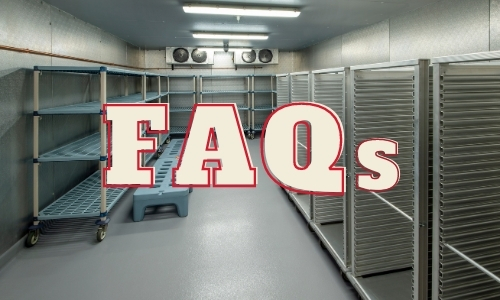
Learning About Walk-In Freezers
Freezers are fairly well-known appliances, especially in the middle of the summer. They keep food and other products frozen, which allows them to last months without going bad. However, most commercial kitchens (and some homes) are equipped with walk-in freezers, which work slightly differently. How exactly do they work? Let’s consult local HVAC and refrigeration technicians for more information.
The Mechanical Parts of Walk-In Freezers
Walk-in freezers and coolers are similar in terms of the parts needed to operate them. All walk-in freezers have an evaporator, which freezes the moisture in the air and works to perform a protective barrier that helps fight heat transfer on the inside of the unit. This is one mechanical part of three very important parts of the walk-in freezer cooling cycle, as it removes heat from the air and transfers it into the coolant (or refrigerant). They also have a condenser that takes the heat out of the freezer and vents it outside of the unit with the help of fans. This is very similar to the evaporator, except that it works in the opposite fashion. The final major part of walk-in freezers is the compressor. The compressor works in combination with the evaporator and the condenser to add pressure to the freezer’s refrigerant. The refrigerant then cycles through the unit to absorb heat and keep the freezer cool. Without the compressor, the refrigerant would not be able to be hot enough to complete its cycle through the unit.
How Are Walk-In Coolers and Freezers Different?
The main difference between freezers and coolers is the temperature at which they keep food. Most coolers will keep the temperature at 41 degrees Fahrenheit or lower, while freezers hold steady around 0 degrees Fahrenheit. Walk-in freezers have larger, more powerful refrigeration systems due to the lower temperatures they need to maintain. They also commonly have thicker walls to keep all of that cold air inside.
Another difference between these units is that a freezer normally needs some kind of floor insulation to stop ice from accumulating on the floor of the walk-in. This is because a walk-in freezer is so powerful that it actually can freeze the condensation and humidity coming up from underground.
When Is It Time For a Freezer Replacement?
While most walk-in freezers were designed to last many years, there are definitely some situations where the unit may need to be replaced. Eventually, the normal wear and tear on the unit becomes too much and parts begin to break down. These units should be replaced after around 15 years, or sooner if any of the following issues are noted. The freezer is losing its efficiency and not keeping the temperature as low as it should be. There is obvious damage to the external parts of the unit, including deteriorating metal skins, foam insulation that is separating, etc. The freezer is starting to collect frost or condensation inside the unit. Just like all appliances, to keep walk-in freezers running at their best they should be serviced regularly by professional HVAC and refrigeration technicians.
About Skovron Mechanical Services LLC.
Established in 2005, Skovron Mechanical Services LLC. is located in Manchester, New Hampshire. Their team is fully insured, licensed, and EPA Certified for Air Conditioning, as well as receiving 30 hours of training every month.